
release order… did not hold for a single afternoon.
A Sacramento County retail theft case was solved in April when detectives linked roughly fifty thefts at Home Depot and Lowe's locations to a single suspect. Losses topped twenty thousand dollars. The pattern was the classic organized retail crime cycle. Walk in, grab high value power tools, walk out, and convert them to cash within hours at a chain of cooperating pawn shops. North City Pawn, Action Loan and Pawn, and Gold n Pawn appeared throughout the case file as the resale endpoints.
The detail that should get every hardware retailer's attention is what happened after the arrest. A judge set bail at one hundred thousand dollars. The suspect was released on his own recognizance with pretrial probation and a court order to stay out of every Home Depot and Lowe's in Sacramento County. Within hours of release, he walked into another Home Depot, took a $650 DeWalt table saw, and sold it to a different pawn shop.
This is not a story about whether the courts are doing their job. It is a story about where retail theft actually has to be stopped. By the time a suspect has driven to the pawn shop with merchandise on the front seat, the loss has already happened. The store has missed margin, missed inventory, and absorbed the labor cost of a future investigation. The only point in that cycle a retailer fully controls is the front door.
Why power tools
Power tools are one of the cleanest products in retail to fence. They hold value, they are recognizable across brands, they have predictable resale prices, and pawn shops will move them quickly. A single boxed circular saw can return more cash in twenty minutes than a cart full of clothing. This is why ORC crews specifically target tool aisles, why the same crews repeat-hit the same stores, and why a suspect under a stay-away order will go right back to the category that pays.
California's broader numbers reinforce the pattern. The state's Organized Retail Crime Task Force, led by the California Highway Patrol, recovered more than 33,000 stolen items and 3.3 million dollars in merchandise across the first two months of the year.
Recovery is not prevention. Once an item is recovered through a task force, it has already been stolen, fenced, and tracked. The cost of that loop, in shrink, in store labor, and in police hours, dwarfs the cost of stopping the merchandise from leaving the building in the first place.
What works at the door
EAS, properly specified for the merchandise category, is the layer that interrupts the theft before it becomes a recovery problem. For power tools the right hardware is not a sticker label. It is a physical barrier paired with detection.
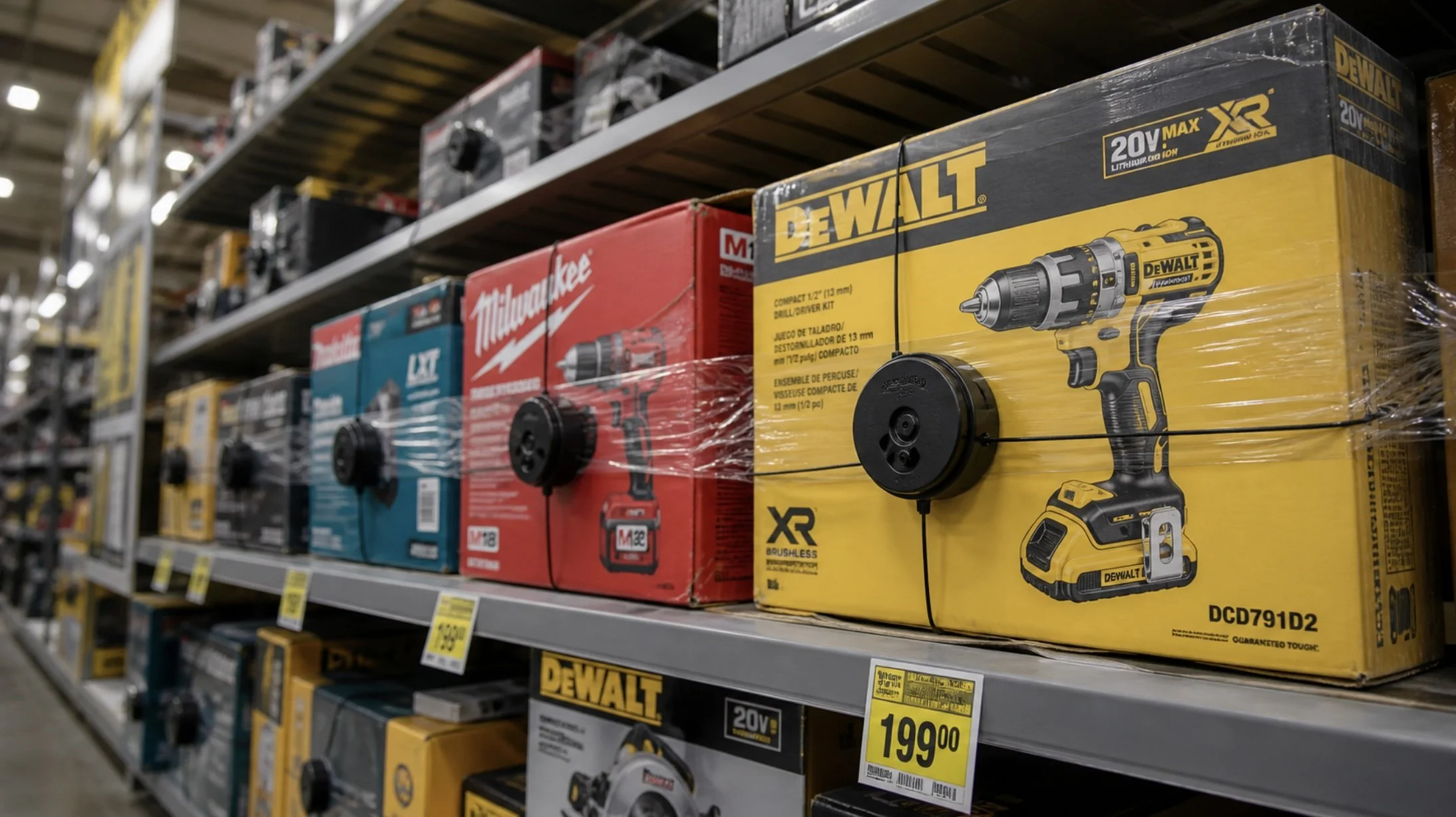
Cable locks are the workhorse for boxed power tools. The cable wraps the box and engages a lock that triggers an alarm if cut, removed without the right detacher, or carried past the pedestals at the front of the store. They are visible by design. A shoplifter scouting a tool aisle reads a cable lock the same way they read a camera dome. It signals friction.
Spider wraps add a second layer for higher-value boxed items. The wrap encloses the box on multiple sides with hardened cable, making it impractical to defeat in the aisle. For tools that retail above three or four hundred dollars, spider wraps move from optional to standard.
EAS at the front door does the rest. When a tagged item crosses the pedestals without being deactivated or detached, the system alerts. Whether the alert leads to recovery, deterrence, or both depends on store policy, but the alert is the trigger that turns a quiet exit into a documented event with video, time stamp, and a chance to recover the item before it ever reaches a pawn shop.
Choosing the system
Hardware stores tend to have wide entrances and high traffic exit lanes. That geometry favors AM systems, which is the technology used by Sensormatic. Certain Sensormatic AM systems can cover up to eight feet between pedestals, which fits the layout of a typical big box hardware exit without requiring extra towers in the aisle. AM hard tags and locks are also robust enough to survive the rough handling that tool packaging gets on a warehouse style retail floor.
Checkpoint RF is the right answer when label thickness matters. RF labels are paper thin, which is why they dominate in pharmacies, cosmetics, and packaged goods where a thicker tag on the front of a box would be visually disruptive. Both technologies are now being integrated with RFID, so retailers do not have to choose between loss prevention and inventory visibility regardless of which platform they run.
For a hardware retailer the practical mix is usually AM pedestals at the door, cable locks and spider wraps on the boxed power tool wall, and labels on smaller packaged accessories that cannot physically accommodate a hard tag.
The lesson from Sacramento:
One suspect, fifty thefts, two retailers, three pawn shops, and a release order that did not hold for a single afternoon. The case will close eventually. The merchandise will be partially recovered. The store will absorb the rest as shrink. None of that is the same as the merchandise never leaving the floor.
Every retailer in a high target category should treat cases like this one as a planning input rather than a news story. If your power tool aisle is not protected with the right combination of EAS detection and physical tagging, the next ORC offender will treat your store the same way the last one treated Home Depot. Courts and task forces will do their work after the fact. Your front door is the only layer that decides whether the loss happens at all.
Retail Security Group Inc. provides professional EAS installation, maintenance, and consultation across all forty eight continental United States. We help hardware retailers and big box stores specify the right combination of pedestals, hard tags, cable locks, and spider wraps for their layout and product mix. Contact us at Info@SecurityTagStore.com.