
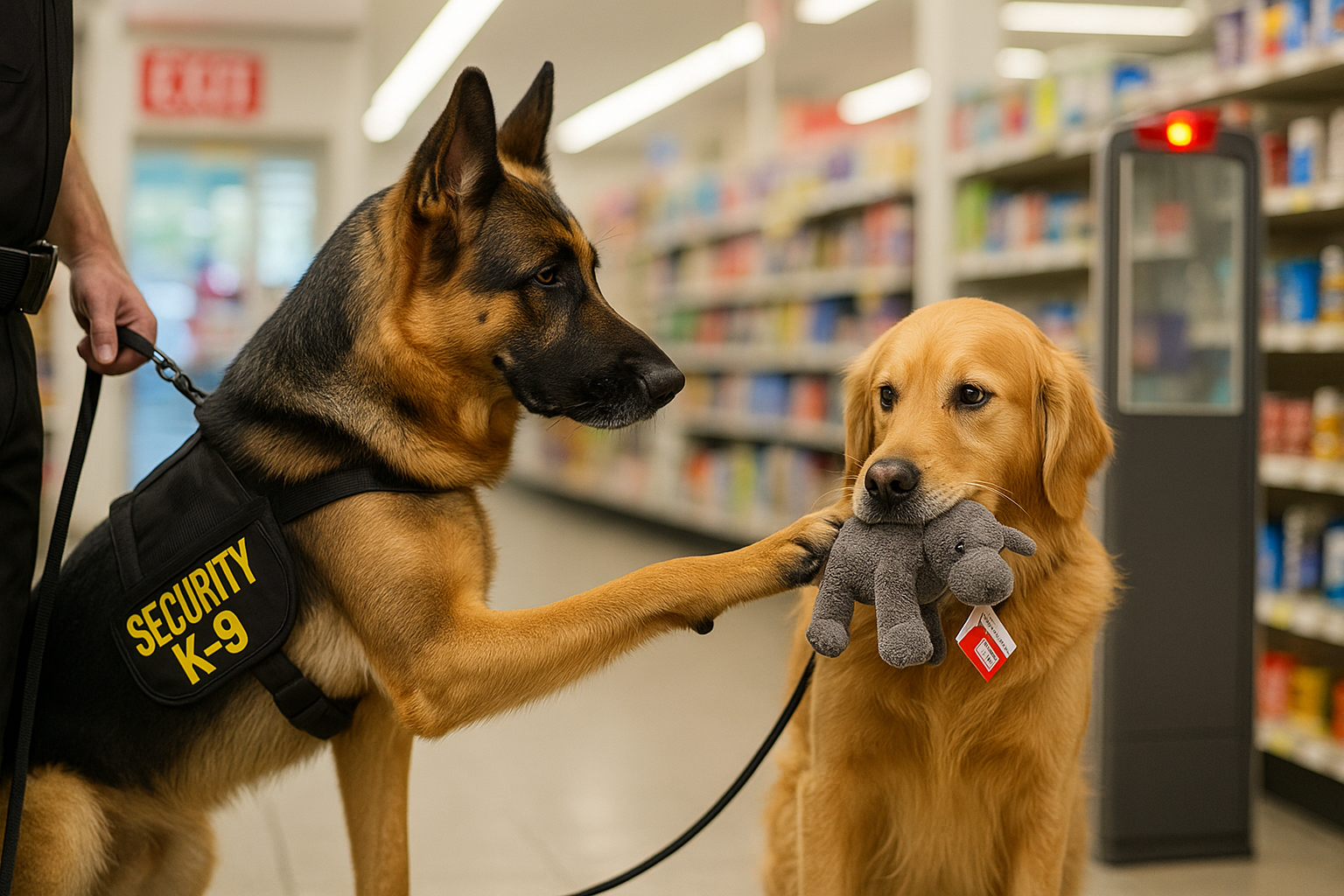
K-9 stops shoplifting dog…
Two true stories:
A Midtown NYC trade group posts K-9 teams at a CVS to deter rampant theft.
A very good boy named Percy keeps “adopting” toys from a pet shop, no receipt, wagging tail, zero remorse.
Together they’re a perfect lens on retail loss prevention in 2025: serious problems, creative solutions… and a reminder that sometimes the culprit just wants a squeaker.
The Serious Tail: Dogs Deterring Human Shoplifters
In New York City, the 34th Street Partnership piloted a program with Stapleton Security to station trained dogs and handlers inside and outside a CVS near 34th & 8th. The mission is deterrence, not pursuit: the dogs don’t chase; they signal that someone is paying attention.
The early anecdotes are exactly what you’d hope from a deterrence layer. Known boosters see a 100 plus-pound German Shepherd or Malamute with a professional handler and poof decide they didn’t need those armfuls of deodorant after all. Store managers report serial shoplifters who turn around at the door or drop merchandise when the team approaches. It’s the oldest security effect in the book: visible guardianship changes behavior before loss occurs.
Of course, presence isn’t cheap. Handlers and dogs run long shifts, seven days a week, at a five-figure monthly cost. And the business district’s leaders have been candid: canine patrols help, but they’re asking the city for more consistent police foot patrols. Meanwhile, retailers juggle other tradeoffs, locking everyday items behind plastic slows theft and service, which requires more labor to unlock, which increases costs again. In a world where shrink is estimated in the tens of billions annually, you do what works now while you lobby for what’s needed long-term.
Bottom line: K-9 teams are a behavioral technology. Think of them as living signage that says, “Not today.”
The Comic Relief: When the Shoplifter Is… the Dog
Enter Percy, a rambunctious Portuguese water dog who treats a local pet store’s toy aisle like his personal subscription service. He browses, he sniffs, he selects, and, unless a human intervenes, he’s headed to the exit to begin a rigorous at-home product evaluation.
Percy’s person has discovered a restorative justice meets Milk Bone tactic: treats at the ready. A gentle “drop it,” a reward, toy back to the bin, retail equilibrium restored. If only all shrink were this straightforward; imagine police reports that read “Suspect complied upon presentation of biscuit.”
It’s a perfect, harmless vignette that also winks at a truth retailers live every day: we design stores for humans, but lots of behaviors, impulsive grabs, distracted exits, unintended carry outs, look the same whether the hands are gloved or the paws are fluffy.
What the Anti-Theft Tech Thinks (Species Agnostic Security 101)
Whether the “shoplifter” is a person or a very determined corgi-shepherd, electronic article surveillance (EAS) doesn’t care. Here’s the quick, plain-English version:
Two main flavors for pet supply stores:
RF (8.2 MHz) labels—thin “sticker” tags you deactivate at checkout.
AM (58 kHz) hard tags—the plastic security tags or pins you remove with a detacher at checkout; lanyards for odd shapes.
Pedestals at the door create a detection zone. If an active tag (not deactivated/removed) crosses that zone, the system alarms, no judgment, no bias. Backpack, stroller, baby seat, or… a Labrador with a plush alligator in his mouth, alarm all the same.
Checkout is the off ramp: Cashiers either deactivate RF labels or detach AM hard tags. When stores forget to do this, you get “honest alarms” from paying customers on their way out.
Design choices matter: Not every SKU should be tagged (friction!), but high-risk, high-velocity items often are. Pet retailers sometimes tag premium chews, supplements, flea/tick meds, or popular toys, especially near doors.
In other words, if Percy nabs a tagged plush and beelines for daylight, the pedestals will sing. And if a human booster tries the same with dry food or KONG? Same song, same dance.
Why Dogs Work (on Both Sides of the Door)
As guardians: Trained K-9 units project calm authority. They change the cost-benefit math for opportunistic theft without physical confrontation. People self select out. Staff feel supported. Customers often feel safer.
As “offenders”: Dogs are adorable studies in unintended loss. Percy isn’t malicious; he’s curious, tactile, and strongly motivated by fun. That’s the same cocktail that fuels some human “it’s small, they won’t miss it” behavior. Which is why visible deterrents, smart merchandising, and EAS are designed to interrupt that moment.
Practical Takeaways for Retailers
Blend layers: Pair visible deterrence (K-9 teams, attentive greeters, mirrors) with EAS at exits and clean checkout(detachers at every lane, consistent deactivation).
Merchandise with intent: High-risk items near staff; tether or case the ultra-tempting stuff; tag what truly moves loss, not everything.
Design for dignity: The goal is fewer confrontations and smoother shopping, not a fortress. Deterrents should feel like hospitality with backbone.
Measure the right things: Not only “stops” but reductions in attempts, fewer open packages, less time locked case assisting, and customer sentiment.
Practical Takeaways for Pet Parents (and Percys)
Keep a pocket of treats on “browse days.” Treats stop many crimes of passion.
Ask before you let your dog peruse the toy wall; staff will often hand you one to test.
If the exit sings, check for a forgotten tag not all alarms mean malice.
The Juxtaposition That Sticks
On one sidewalk, a handler stands quietly with a steady dog and a steadier gaze, and would be thieves decide today isn’t the day. On another, Percy selects a plush hedgehog and heads for the door, blissfully unaware of retail policy or RF labels, until a treat and a smile redirect him to a lawful life.
Same aisle, different tails. And in between those tails is the throughline of modern loss prevention: use psychology first, technology always, and when you can, keep some humor in your pocket next to the dog treats.
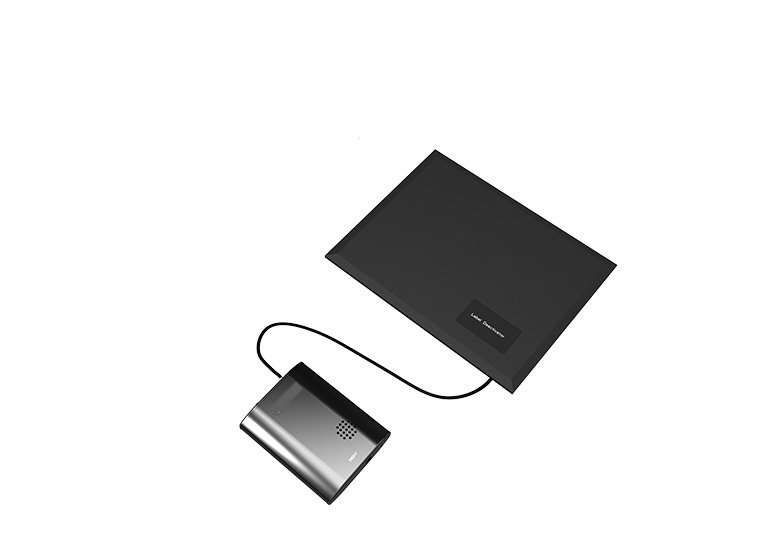
The Premium RF Deactivator is a brand-new, high-performance deactivation system designed to efficiently deactivate 8.2 MHz RF labels in retail environments. This complete unit includes one deactivator chassis and one pad, providing fast, reliable, and seamless checkout operations. With audible feedback and consistent deactivation accuracy, this system enhances security and efficiency at the point of sale.
Key Features:
Reliable Deactivation – Effectively deactivates 8.2 MHz RF labels, ensuring smooth checkout operations.
Dual Register Capable – Includes one pad, with the option to add a second pad for multi-register setups.
Audible Feedback – Emits a clear beep to confirm successful deactivation, improving accuracy and efficiency.
Brand-New Unit – This is a new deactivator system, offering long-lasting reliability and peak performance.
Complete System – Sold as a full unit, including one deactivator chassis and one pad.
Quantity: Sold as a complete deactivator unit with 1 chassis and 1 pad.
Upgrade your retail security and checkout efficiency with this new RF deactivator. Order now for reliable deactivation performance!
Product Code: C3001-CD Premium Deactivator - RF - New - Complete Deactivator
https://warwickonline.com/stories/how-to-curb-your-dogs-shoplifting,280406