
Tariffs are still squeezing margins….
The war overseas dominates every news cycle. Tariffs do not. But walk into any buyer’s office at a mid size retailer right now and tariffs are still the conversation that keeps people up at night. The reason is simple. The full cost of the tariff policies enacted in 2025 did not hit store shelves immediately. They are hitting now, in 2026, and retailers are running out of room to absorb them.
Walmart told investors that tariff related costs have lifted prices across multiple categories, with general merchandise inflation climbing above 3 percent. Target’s leadership has called price increases a last resort but acknowledged that its heavier reliance on imported goods leaves fewer places to hide. According to the National Retail Federation, import cargo volumes have declined year over year heading into 2026 as retailers pull back on orders they are not confident they can sell at viable margins.
A Federal Reserve Bank of New York analysis found that U.S. businesses and consumers absorbed roughly 90 percent of the economic burden from the 2025 tariff increases. For retailers operating on margins that were already thin before the trade war, that math is brutal. Every fraction of a percentage point matters. And that is exactly where loss prevention enters the picture.
Why Shrink Hurts More When Margins Shrink
Retail shrink in the United States reached an estimated 45 billion dollars in 2024 alone. The National Retail Federation reported an 18 percent increase in shoplifting incidents that same year compared to 2023, with threats and violence during theft events climbing 17 percent. Those numbers were alarming when margins were stable. Under tariff pressure, they become existential.
Think about it this way. A retailer absorbing a 10 percent tariff increase on a product that already carried a slim margin might be making two or three dollars of profit on a 30 dollar item. Lose that item to theft, and the store has not just lost the profit. It has lost the landed cost of the goods, the tariff paid on import, and the labor it took to get the product onto the shelf. In a tariff environment, every stolen item represents a bigger financial hit than it did two years ago.
This is not a theoretical problem. More than half of U.S. retailers are expected to increase their investment in loss prevention technology by the end of 2026. The retailers doing the math understand that protecting inventory is no longer just a security line item. It is a margin protection strategy.
EAS Is the Foundation
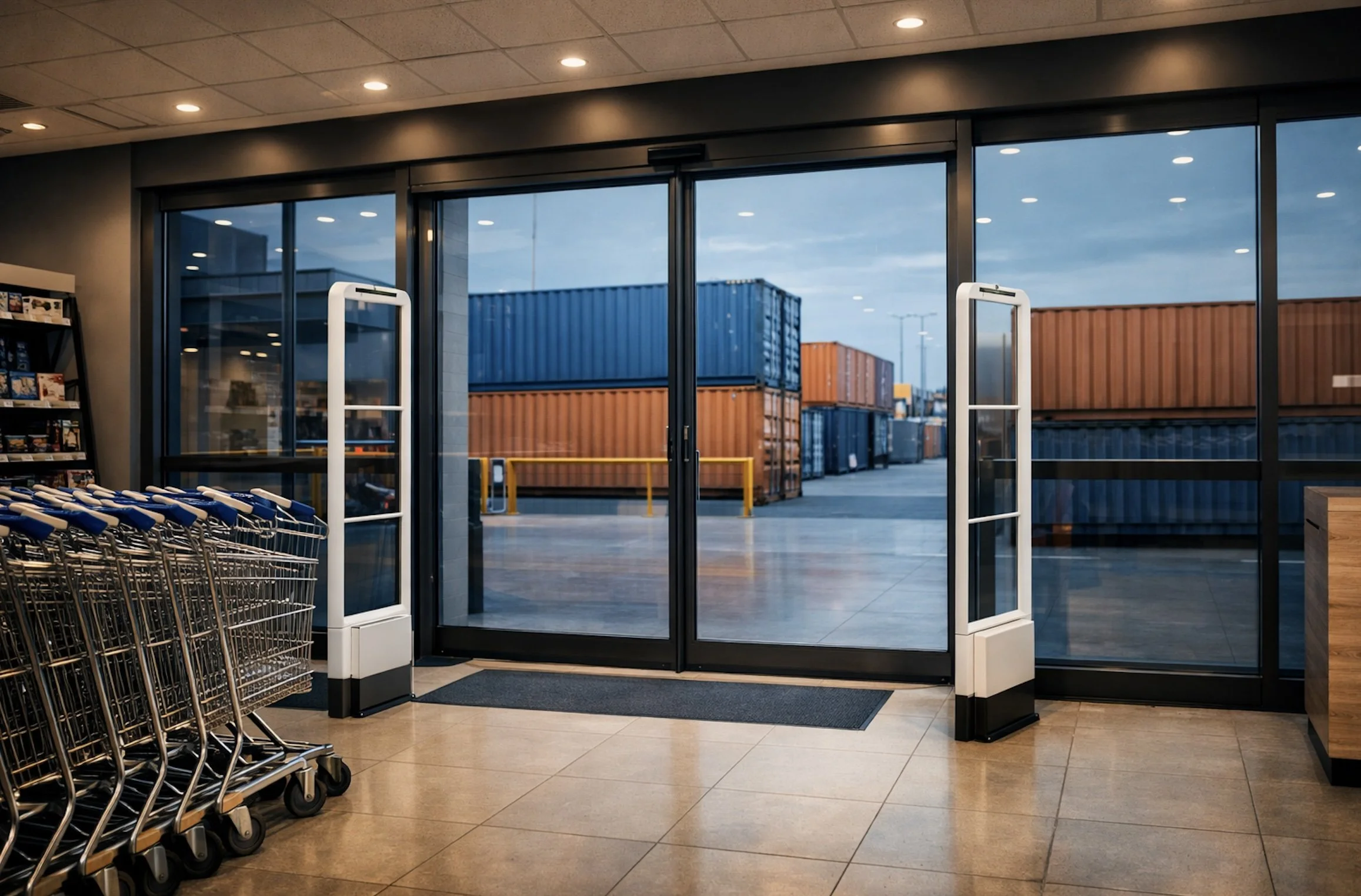
Electronic Article Surveillance remains the most widely deployed and cost effective first line of defense against retail theft. The technology has been around for decades, but the fundamentals have not changed because they work. An EAS system does two things simultaneously. It deters theft through visible presence and it detects theft attempts at the point of exit. No camera system, no analytics platform, and no staffing model replaces that combination.
The two dominant EAS technologies in North America are RF and AM. Checkpoint Systems operates on RF technology at 8.2 MHz. Sensormatic operates on AM technology at 58 kHz. The distinction matters because each technology has specific strengths that align with different retail environments.
RF systems from Checkpoint produce paper thin labels that are virtually flat against packaging. That makes RF the preferred choice for pharmacies, cosmetics counters, health and beauty aisles, and any environment where a label needs to sit discreetly on a box or blister pack without adding bulk. When your tariff inflated inventory includes high value packaged goods, protecting it with a label the customer barely notices is a significant advantage.
AM systems from Sensormatic offer wider pedestal coverage, with certain configurations reaching up to 8 feet between pedestals. For retailers with large entryways, wide aisles, or open floor plans, that coverage gap matters. AM detection is also known for strong resistance to false alarms, which keeps lines moving and staff focused on real events instead of chasing phantom alerts.
Both technologies support hard tags and soft labels. Both perform well in high traffic environments. And both are now being integrated with RFID, giving retailers the ability to combine loss prevention with real time inventory visibility regardless of which EAS platform they run.
Hard Tags Are the Priority
If your store sells merchandise that can physically accommodate a hard tag, you should be using hard tags. This is not a cost discussion. It is a performance discussion.
Hard tags deliver better detection rates than labels. They are significantly more difficult for shoplifters to remove or defeat in the field. They are reusable, which means the per use cost drops over time. And they serve as a visible psychological deterrent. A shoplifter deciding between two similar items at two different stores will choose the one without the tag. That deterrent effect never shows up in a shrink report, but every loss prevention professional knows it is real.
Labels fill a critical gap for product categories where hard tags simply cannot go. Boxed electronics, blister packed cosmetics, over the counter medications, and grocery items all need label protection. But for apparel, accessories, footwear, handbags, and sporting goods, hard tags should be the default.
For high risk merchandise, ink tags add another layer. When tampered with, ink tags rupture and destroy the garment, eliminating any value to the thief for personal use, return fraud, or resale. Specialty tags like bottle locks for wine and spirits, spider wraps for boxed electronics, and cable locks for power tools extend EAS protection into categories that standard tags and labels cannot cover.
The Tariff Connection Is Direct
Retailers cannot control trade policy. They cannot control what tariff rates will be next quarter or next year. But they can control how much inventory walks out the door without being paid for. In an environment where the landed cost of every product on the shelf has gone up, the financial penalty for unprotected merchandise has gone up with it.
The retailers who are navigating this environment successfully are not treating loss prevention as an expense to be minimized. They are treating it as a margin preservation tool. A properly deployed EAS system, matched to the store’s layout and merchandise mix, pays for itself by preventing losses that now carry a higher replacement cost than they did before tariffs entered the equation.
The NRF reported that internal and external theft, including organized retail crime, accounts for 65 percent of overall retail shrink. That is not a problem you solve with cameras alone. It is a problem you solve with a layered approach, and EAS is the foundation layer.
Retail Security Group Inc. provides professional EAS installation, maintenance, and consultation for retailers across all 48 continental U.S. states. Whether you need a new system designed from the ground up or a review of your current setup to make sure it is performing at full capacity, our team can help. Contact us at Info@SecurityTagStore.com
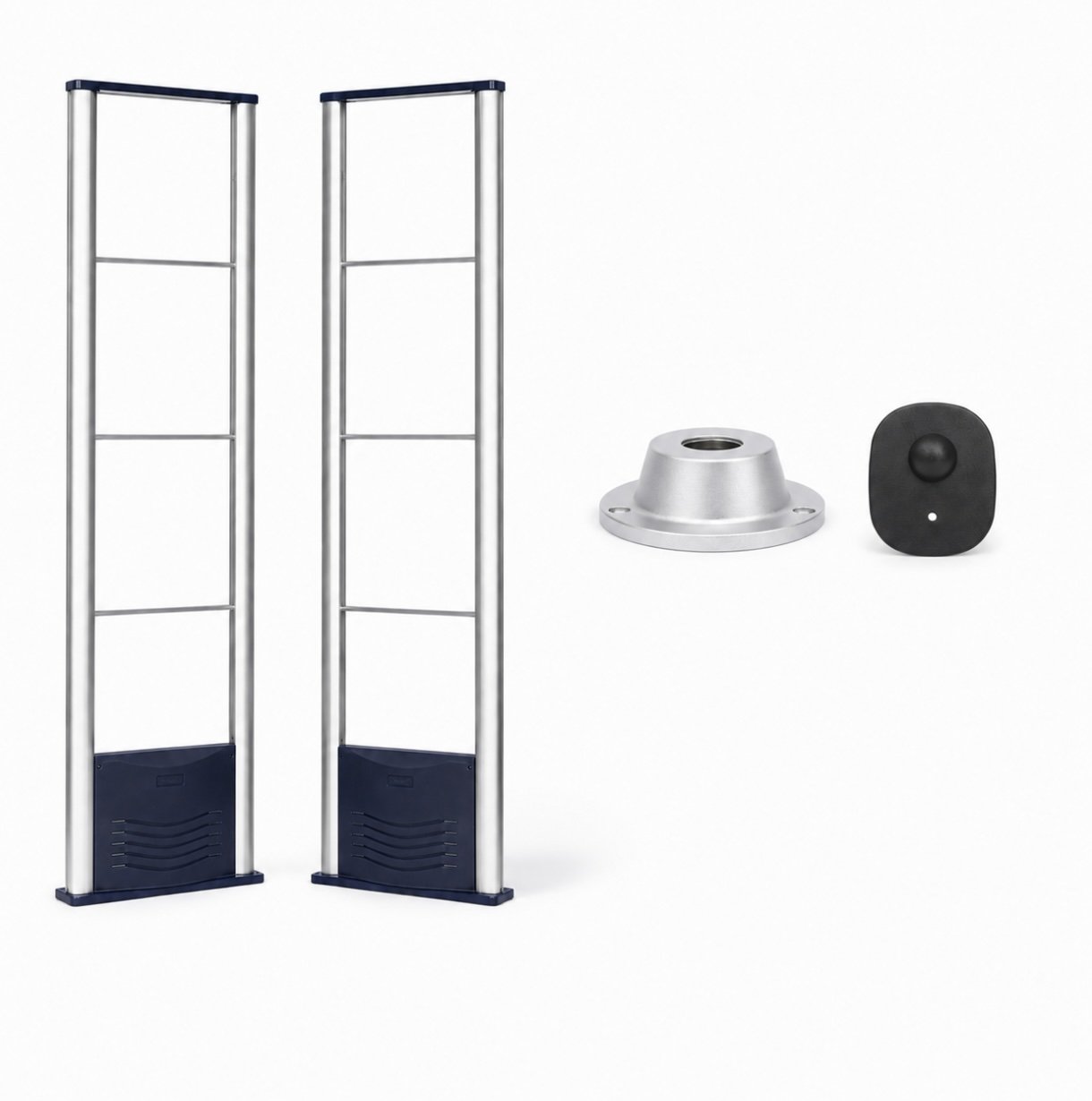
Get your store protected end to end with the G1000 Dual Pedestal Security Tag System Package, a complete new RF 8.2MHz EAS solution with professional installation included. Two Century G1000 pedestals cover entrances up to 12 feet wide, 6 feet between the pedestals plus 3 feet on each outer side, and ship with 1,000 black mini hard tags, 1,000 grooved flat head pins, and a universal mini detacher so you can start tagging apparel and accessories right away. Installation is included in most areas of the continental U.S.
Key Features
Complete security system: Pedestals, tags, pins, and detacher in one turnkey package.
Dual pedestal coverage: Detects RF 8.2MHz tags across up to 12 feet of entrance width.
1,000 mini hard tags: Compact black RF 8.2MHz hard tags ideal for apparel, accessories, and general merchandise.
1,000 grooved flat head pins: Secure attachment, fully compatible with the included mini hard tags.
Universal mini detacher: Lightweight counter detacher for quick, damage free checkout.
Professional installation included: Covered in most of the continental U.S.; excluded remote areas can pay an additional fee or receive a full refund prior to shipment.
Quantity: System package: 2 G1000 RF pedestals with power supply, 1,000 black mini hard tags, 1,000 grooved flat head pins, 1 universal mini detacher, professional installation
Product Code: C1005-SP1 G1000 Dual Pedestal Security Tag System Package, 8.2MHz, New